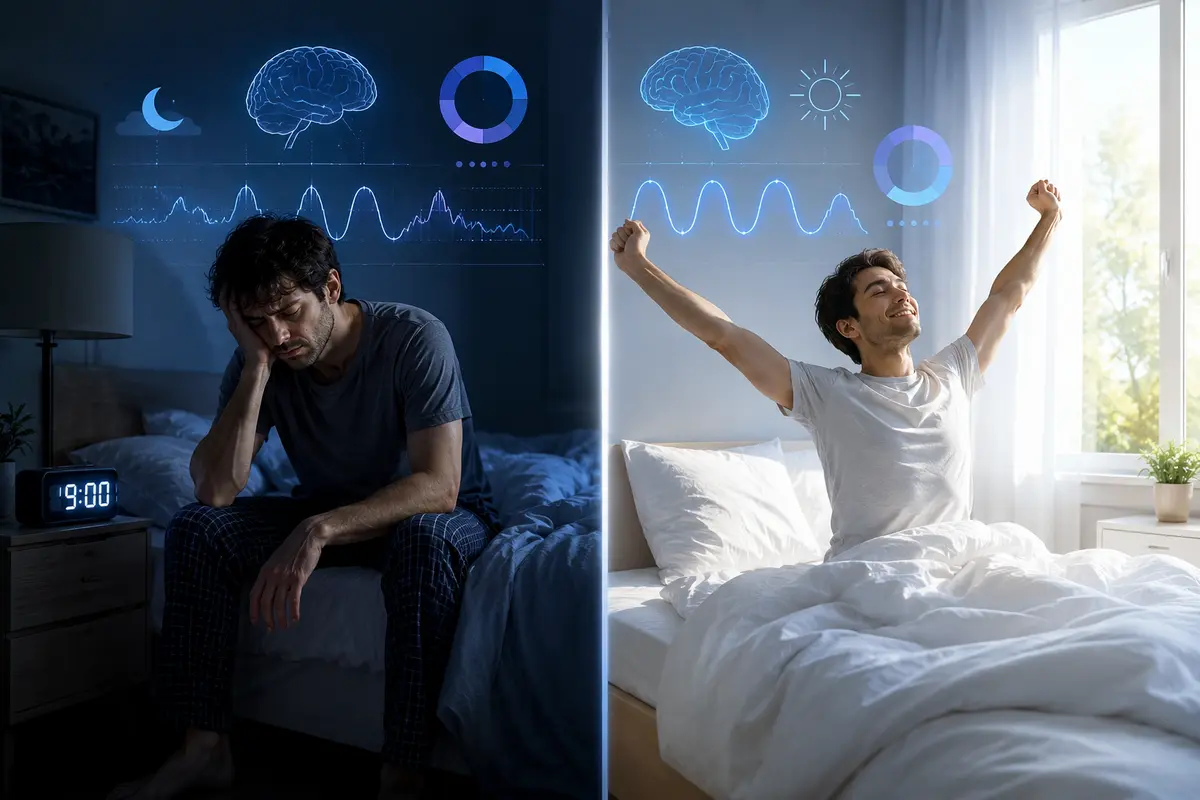

You slept eight hours last night. Maybe even nine. And yet here you are, dragging yourself through the morning like sleep never happened.
That frustration is more common than you’d think, and there’s a real reason behind it. The debate around sleep quality vs sleep quantity comes up constantly, and for good reason. Most of us were raised to believe that eight hours is the magic number. Get your eight, wake up refreshed. Simple.
Except it’s not that simple. Hours in bed and hours of actual restorative sleep aren’t the same thing. Understanding the difference between sleep quality and sleep quantity could genuinely change how you feel every day and how you respond to it.
I know this feeling better than I’d like to admit. For a long time, I was sleeping well past eight hours and still couldn’t pull myself out of bed in the morning. The mattress felt like it had a grip on me, genuinely, physically comfortable in a way that made getting up feel impossible. I’d lie there for another hour or two before my brain finally accepted that the day had started. I thought I was just lazy. Turns out, I was sleeping a lot and resting very little.
What People Mean by “Quality” and “Quantity” of Sleep
Before comparing them, it helps to know exactly what each one means.
Sleep Quantity: Definition and Guidelines
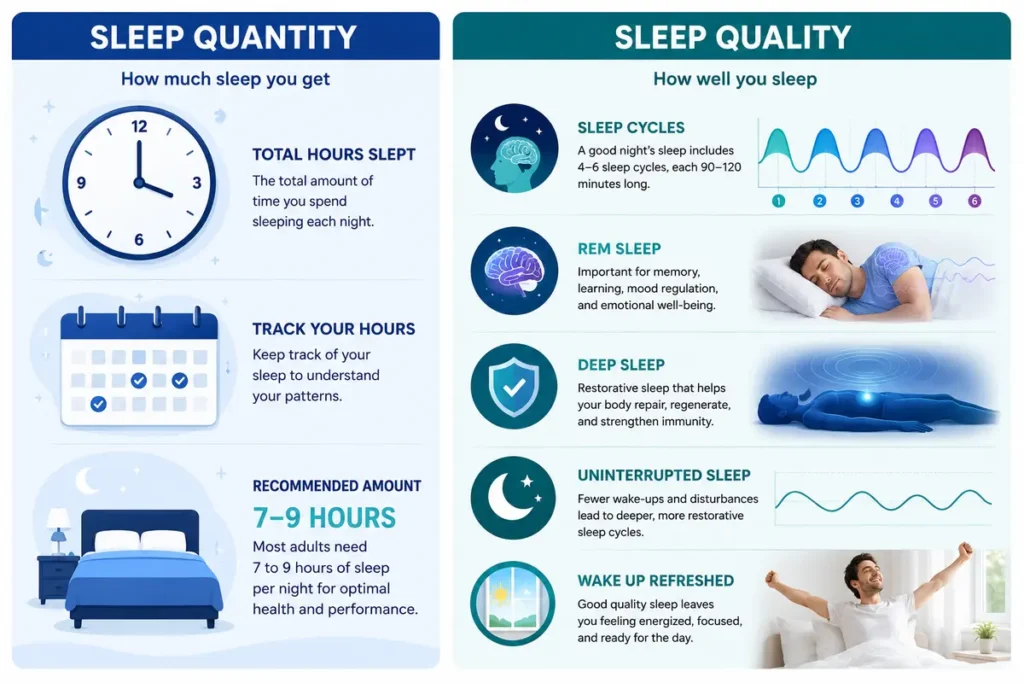
Sleep quantity is straightforward: it’s the total number of hours you sleep each night. That’s it. If you get into bed at 11 p.m. and wake up at 7 a.m., you’ve clocked eight hours of sleep quantity, regardless of how that sleep actually went.
Most adults need between 7 and 9 hours per night, according to the CDC. Teenagers need more. Older adults often need slightly less. These ranges exist because sleep deprivation, consistently falling short of your body’s needs, has well-documented effects on health, cognition, and mood.
Quantity is the foundation. Without enough hours, nothing else can save you.
Sleep Quality: Definition and Measurable Markers
Sleep quality is harder to define but arguably more important to understand. It describes how well you sleep within those hours, not just that you slept.
Good sleep quality means:
- You drift off within roughly 30 minutes of hitting the pillow
- You don’t wake up more than once during the night and fall back asleep quickly
- You wake up feeling restored and alert, not groggy or heavy
- You feel reasonably energetic throughout the day without relying on caffeine to function
Poor sleep quality looks like the opposite: tossing and turning, waking at 2 a.m. with your mind racing, or stumbling through your mornings even after a “full night.”
Key Metrics: Sleep Efficiency, Awakenings, Latency, and Deep Sleep
Sleep researchers use a few specific markers when measuring quality:
- Sleep latency: how long it takes to fall asleep (under 20 minutes is considered healthy)
- Sleep efficiency: the percentage of time in bed that you’re actually asleep (85% or above is the target)
- Awakenings: How many times do you wake during the night
- Time in deep sleep and REM sleep: the stages where physical restoration and memory consolidation actually happen
Your sleep architecture, the pattern and proportion of sleep stages throughout the night, determines whether your body gets what it needs. Fragmented or shallow sleep disrupts this architecture, no matter how long you stay in bed.
Why the Difference Between Sleep Quality and Quantity Matters
Both matter. But they affect you in distinct ways, and the gap between them explains why so many people feel unrested despite technically getting “enough” sleep.
Cognitive Function, Mood, and Daytime Performance
Sleep is when your brain consolidates memories, clears metabolic waste, and regulates emotional responses. Deep sleep handles physical repair. REM sleep handles mental processing and emotional regulation.
When sleep quality is poor, those processes get interrupted. The result isn’t just tiredness. It’s slower thinking, worse decision-making, a shorter fuse, and difficulty concentrating. You might not notice it acutely, but the cumulative effect adds up fast.
Long-Term Health: Cardiovascular, Metabolic, Immune
The American Heart Association recently expanded its cardiovascular health checklist to include sleep as one of eight essential health behaviors. That’s not a small thing. Research links consistently poor sleep quality, not just short sleep, to a higher risk of heart disease, type 2 diabetes, obesity, and weakened immune response.
Spending 10 hours in bed with fragmented sleep isn’t protective. If anything, it can mask a deeper problem while the damage quietly accumulates.
When Quantity Alone Can’t Compensate
This is the scenario most people don’t expect: more sleep, same exhaustion. If your sleep is fragmented, too shallow, or you’re spending most of your time in light sleep stages, extra hours won’t fix it.
Think of it like trying to charge your phone with a frayed cable. The connection exists, but the charge barely gets through.
My fix back then was coffee. Wake up exhausted, drink coffee, feel human for about an hour. Then a heavy breakfast and I’d crash right back into the same fog, slow movements, heavy eyes, that familiar tired face by mid-morning. Some days I’d squeeze in a nap to get through. It worked just enough to keep me going, but never enough to actually fix anything.
How Sleep Quantity and Quality Interact
They’re not separate systems. They shape each other. And the science behind their relationship is worth understanding.
Sleep Cycles, Deep Sleep, and REM
A normal night’s sleep consists of 4 to 6 sleep cycles, each lasting about 90 minutes. Each cycle takes you from light sleep down into deep slow-wave sleep, then back up into REM.
Deep sleep is heaviest in the first half of the night. REM sleep dominates the second half.
If you cut sleep short, say, getting only 5 hours, you lose disproportionately more REM sleep, since REM is concentrated in early morning hours. A deep sleep deficit shows up differently: it often means fragmented sleep throughout the night, which is more often a quality problem than a quantity one.
Circadian Timing and Sleep Quality
When you sleep matters, not just how long. Your circadian rhythm, the internal 24-hour clock that regulates nearly every biological function, determines when your body is primed for sleep. Fighting it is possible, but costly.
Sleeping from 9:30 p.m. to 4:30 a.m. versus midnight to 7:30 a.m. might technically be the same duration, but your body doesn’t experience them the same way. Misaligning your sleep timing with your circadian rhythm reduces sleep quality, even if the hours look fine on paper.
The thing that actually opened my eyes wasn’t research. It was a friend. He’s one of those people who always seems switched on, always in a good mood, always energetic. I finally asked him what his secret was. He looked at me like the answer was obvious: he goes to bed at 11 p.m. every night and wakes up around 7 to 7:30 a.m. No exceptions. That consistency was doing more for him than any supplement or lifestyle hack. I started taking sleep timing seriously from that point on.
Hormones: Cortisol, Growth Hormone, and Timing
Sleep is hormonally precise. Growth hormone, essential for tissue repair, immune function, and metabolism, is released primarily during deep sleep in the first few hours of the night. Cortisol, your stress hormone, naturally rises toward morning to help you wake up alert.
Disrupted or poorly timed sleep throws this rhythm off. Chronically elevated cortisol from poor sleep makes it harder to fall asleep the next night, creating a cycle that feeds itself.
Common Real-World Scenarios and What to Prioritize
The abstract debate becomes clearer when you look at real situations.
Short Nights (3 to 5 Hours): Triage Mode
If you’re only getting three to five hours, whether from a newborn, a deadline, or exam prep, quality becomes almost irrelevant. At that level of deprivation, your body needs more sleep, period. A short nap (20 minutes or 90 minutes to complete a full cycle) can help bridge the gap. Caffeine can manage alertness short-term, but it doesn’t restore the cognitive functions lost from sleep deprivation.
When You Sleep Less But Sleep Well: Does 7 Hours Actually Cut It?
For most healthy adults, yes. If that sleep is genuinely good quality, 7 hours is enough. Some people naturally thrive on 6.5 to 7 hours if their sleep efficiency is high and they hit adequate deep and REM sleep. What you want to avoid is mistaking 7 fragmented hours for 7 good ones.
Long Sleep with Poor Quality: Why More Hours Can Still Leave You Tired
Nine hours in bed, still dragging yourself through the morning. This one catches people off guard. It’s usually a quality problem. Common culprits: sleep apnea (which fragments sleep dozens of times per hour without you remembering it), stress, alcohol before bed, or an irregular schedule disrupting sleep architecture.
Shift Work, Irregular Schedules, and Social Jet Lag
People who work nights or rotate shifts deal with a specific challenge: their sleep timing fights their circadian biology. Even if they log enough total hours, sleep quality suffers because the body isn’t set up for daytime sleep. Social jet lag, shifting your sleep schedule dramatically on weekends, creates a similar drag, essentially giving you mild jet lag every Monday.
Practical Steps to Improve Sleep Quality
Life doesn’t always cooperate with an ideal sleep schedule. But you have more influence over quality than you might think.
Bedtime Routine and Sleep Hygiene
Your brain needs cues that sleep is coming. A consistent pre-sleep routine, even just 20 to 30 minutes of low-stimulation activity, trains your nervous system to downshift. Keep your bedroom cool, dark, and quiet. Consistent wake times matter more than consistent bedtimes; anchoring your wake time stabilizes your sleep architecture over time.
For me, the combination that actually worked was simple: a consistent 11 p.m. bedtime, some wind-down time before sleep so my brain had a chance to slow down, and exercise during the day. On days I trained, my sleep was noticeably better, deeper, and less restless. Meditation helped too, especially on high-stress days when my mind wouldn’t stop running through tomorrow’s to-do list.
Light, Devices, and Timing
Blue light from screens suppresses melatonin production and delays your circadian rhythm. Switch off screens, or at least drop the brightness, at least an hour before you sleep. If that’s not realistic, blue-light-blocking glasses or a warm display setting help, though they’re not a complete substitute.
Alcohol, Caffeine, and Late Meals
Alcohol is sedating but sleep-destructive. It cuts into REM sleep and causes you to wake repeatedly during the back half of the night. Caffeine has a half-life of 5 to 7 hours, meaning a 3 p.m. coffee still has half its effect at 8 p.m. Large late meals raise your core body temperature and keep digestion active when your body wants to wind down.
Trackers and When to Trust Them
Wearable sleep trackers can be useful for spotting trends, consistent patterns in your sleep timing, approximate sleep duration, and restlessness. They’re less reliable for specific stage breakdown, like deep sleep and REM. Use them as a general guide, not medical data. The most honest measure of sleep quality is still simply paying attention to how sharp or sluggish you feel by mid-morning.
When to See a Doctor or Get a Sleep Study
If you’re doing everything right and still waking unrefreshed, especially if a partner has noticed snoring, gasping, or breath pauses, sleep apnea is worth ruling out. A formal sleep study (polysomnography) or a home sleep test can diagnose it. Untreated sleep apnea fragments sleep hundreds of times per night and significantly raises cardiovascular risk.

Simple Ways to Boost Sleep Quantity When You Need It
Sometimes the problem isn’t quality. It’s that life keeps cutting sleep short.
Strategic Napping and Sleep Banking
A 20-minute nap improves alertness without causing sleep inertia (grogginess). A 90-minute nap allows a complete sleep cycle, which is better for creativity and memory. Sleep banking, adding extra sleep before a period of deprivation, has some evidence behind it, though it doesn’t fully prevent the effects of sleep loss.
Short-Term vs Long-Term Strategies
After one or two rough nights, a recovery night with a slightly earlier bedtime usually restores baseline function. Chronic sleep debt, built up over weeks or months, is harder to reverse and requires sustained improvement rather than a single long sleep.
How to Tell Which Problem You Have: A Quick Self-Check
Before you try to fix something, it helps to know what you’re actually dealing with.
Ask yourself these five questions:
- Am I getting less than 7 hours most nights? Likely a quantity problem
- Do I wake up multiple times per night? Likely a quality problem
- Does it take me more than 30 minutes to fall asleep regularly? Likely a quality problem, possibly anxiety, or circadian timing
- Do I feel foggy or sleepy during the day, even after 7 to 8 hours? Likely a quality problem
- Has anyone told me I snore heavily or stop breathing during sleep? Possible sleep apnea, worth medical evaluation
If you’re unsure, a two-week sleep diary (tracking bedtime, wake time, night wakings, and next-day energy) is a simple and surprisingly revealing tool. Apps like Sleep Cycle or even a basic notes app work fine.
Frequently Asked Questions
Which is more important: sleep quality or quantity?
You need both, but if pressed, quality edges out quantity. Spending 10 hours in bed with fragmented, shallow sleep doesn’t deliver the same restoration as 7 hours of efficient, uninterrupted sleep. That said, quantity sets the floor. Quality sleep in 4-hour windows won’t make up for chronic sleep deprivation.
Is 7 hours of good-quality sleep enough?
For most healthy adults, yes. Research consistently shows that 7 hours of high-quality sleep supports cognitive function, emotional health, and physical recovery. The keyword is quality. Seven hours of fragmented or shallow sleep is a different story entirely.
What is the 3-3-3 rule for sleep?
The 3-3-3 rule is a pre-sleep habit guide: no alcohol within 3 hours of bed, no food within 3 hours of bed, and no screens within 1 hour of bed (some versions extend this to 3 hours). It’s not a clinical protocol, but it addresses the three most common disruptors of sleep quality in a simple, memorable format.
Does it matter what time I sleep if I get 8 hours?
Yes, more than most people realize. Your circadian rhythm regulates when your body enters deep sleep and when it releases key hormones like growth hormone and cortisol. Fighting your natural sleep window, even with a full 8 hours, usually means shallower, less restorative rest. Consistency in sleep and wake times matters enormously.
Is 9:30 to 4:30 enough sleep?
That’s 7 hours, which is within the healthy range for most adults. Whether it’s enough depends on your individual sleep needs and, more importantly, the quality of those 7 hours. If you naturally wake up around 4:30 and feel rested, your body may be telling you that this timing works well with your circadian rhythm.
How can I measure sleep quality at home?
The most practical tools: a sleep diary (tracking time asleep, wakings, and next-day energy), a wearable like a Fitbit, Oura Ring, or Apple Watch (for trend tracking, not clinical accuracy), and simply paying attention to how sharp or sluggish you feel by mid-morning. If you consistently feel unrested despite enough hours, that’s the clearest sign that something needs to change.
Quick 2-Week Action Plan
You don’t need to overhaul everything at once.
Week 1: Stabilize Timing and Reduce Disruptions
- Set a consistent wake time and stick to it, even on weekends
- Stop caffeine intake after 2 p.m.
- Switch off screens, or at least drop the brightness, at least an hour before you sleep.
- Keep your bedroom cool (around 65 to 68 degrees Fahrenheit / 18 to 20 degrees Celsius)
Week 2: Optimize Depth and Daytime Energy
- Add a short wind-down routine (reading, stretching, light journaling)
- Cut alcohol, especially within 3 hours of sleep
- Track your sleep with a diary or app for a baseline
- Notice your energy pattern across the day. Are you crashing mid-afternoon or waking up genuinely sharp?
When to Escalate
If two consistent weeks of good habits don’t move the needle, or if you suspect sleep apnea, it’s time to talk to a doctor. A referral for a sleep study is straightforward, and treatment for conditions like sleep apnea is often life-changing.
If I could go back, the one thing I’d tell myself is this: stop treating sleep as something to minimize. I spent years following the hustle culture playbook: six hours is enough, sleep less, do more, and genuinely believed I was being productive. The reality was the opposite. When I started protecting eight hours, I got more done. I thought faster, made better decisions, and finished work in less time. The hours I thought I was gaining by sleeping less, I was losing to brain fog and slow thinking. Sleep isn’t a compromise. It’s the foundation on which everything else runs.
Further Reading
- Want to go deeper on the nightly habits side? Our sleep hygiene guide walks you through bedroom setup, wind-down routines, and everything in between.
- Learn how your circadian rhythm affects energy levels, mood, and even digestion throughout the day.
- If stress is disrupting your sleep, our article on stress and sleep breaks down the cortisol connection in practical terms.
- For wearable tracking, check out our overview of sleep trackers and how to actually use the data.