

You wake up after a rough night. Your chest feels tight. Small things feel overwhelming. A mild worry from yesterday has somehow grown into something that feels much harder to shake.
You tell yourself you are just tired. But it keeps happening.
If you have ever noticed that your anxiety feels sharper after poor sleep — or that your mood drops significantly when you have not rested well — you are not imagining it. There is a very real, very well-documented connection between sleep and mental health. And understanding it might be one of the most important things you can do for your well-being.
This article explains exactly how lack of sleep affects anxiety and depression, why the cycle is so difficult to break, and what you can practically do to start feeling better.
The Connection Between Sleep and Mental Health Is a Two-Way Street
Most people think of poor sleep as a symptom of anxiety or depression. And it can be. But what research increasingly shows is that the relationship runs in both directions.
Poor sleep does not just result from mental health struggles — it actively causes them.
When you consistently miss deep, restorative sleep, your brain does not get the overnight maintenance it requires. Emotional processing, stress hormone regulation, and mood stabilisation all happen during sleep. Without it, your mental health starts to deteriorate — even if nothing in your life has changed.
Think of it this way. Your brain is like a phone running on a low battery. It can still function, but everything is slower, more irritable, and less resilient. Sleep is the charger. Without it, even small stressors drain what little charge is left.
How Does Lack of Sleep Cause Anxiety and Depression?
Your Stress Response Goes Into Overdrive
When you are sleep deprived, your amygdala — the part of your brain that processes fear and threat — becomes significantly more reactive.
Studies have found that sleep-deprived people show up to 60% more amygdala reactivity to negative stimuli compared to those who are well rested. Your brain essentially loses its ability to tell the difference between a genuine threat and a minor inconvenience.
This is why everything feels more urgent and frightening after a bad night. Your threat-detection system is stuck on high alert with no way to dial itself back down.
Your Prefrontal Cortex Goes Offline
The prefrontal cortex is the rational, calming part of your brain. It is what helps you think clearly, put things in perspective, and regulate your emotional responses.
Sleep deprivation weakens the connection between the amygdala and the prefrontal cortex. So your panic response fires up — but the part of your brain that would normally say calm down, this is fine cannot get through.
The result is anxiety symptoms that feel disproportionate and impossible to reason your way out of — because physiologically, you genuinely cannot.
Cortisol and Serotonin Get Disrupted
Sleep deprivation raises cortisol — your primary stress hormone — and lowers serotonin, which is one of the key neurotransmitters involved in mood regulation.
High cortisol keeps your body in a state of low-level physiological stress. Low serotonin is directly linked to depression, low motivation, emotional flatness, and persistent sadness.
This combination is essentially what antidepressants are designed to correct. But chronic poor sleep can push your brain into this state naturally — and keep it there.
Can Lack of Sleep Cause Panic Attacks?
Yes — and this is something many people do not realise until it happens to them.
Sleep deprivation lowers your threshold for panic. Your nervous system is already dysregulated, your cortisol is elevated, and your amygdala is hypersensitive. In this state, even a minor physical sensation — a slightly elevated heart rate, a moment of breathlessness — can be misread by your brain as a threat and escalate into a full panic response.
This also explains why some people experience anxiety and heart palpitations after poor sleep. The heart beats slightly faster under cortisol elevation, which an already-anxious brain can interpret as danger, creating a feedback loop that becomes very hard to interrupt.
If you have noticed that your worst anxiety episodes tend to follow your worst nights of sleep, that is not a coincidence.
Can Anxiety Be Worse at Night?
Absolutely — and there is a biological reason for it.
During the day, external stimulation, tasks, and social interaction occupy your brain and provide a distraction from anxious thoughts. At night, when everything goes quiet, there is nothing left to compete with your internal mental chatter.
Additionally, cortisol naturally dips in the evening while melatonin rises. For people whose stress response is already dysregulated due to poor sleep, this hormonal shift can trigger a spike in anxiety as the body misreads the natural evening cortisol drop as a stress signal.
This is why anxious thoughts tend to spiral at bedtime and why people with sleep anxiety often dread going to bed — creating anticipatory anxiety around sleep itself.
Unrefreshing Sleep — When Sleep Does Not Help
Here is something that confuses many people. You can spend eight hours in bed and still wake up exhausted, anxious, and low.
This is called non-restorative sleep or unrefreshing sleep — and it is more common than most people realise.
It happens when sleep is disrupted, fragmented, or lacking in the deep slow-wave stages where emotional processing and nervous system recovery actually occur. You are technically asleep but your brain is not completing the repair work it needs.
People with anxiety disorders often experience exactly this. Their nervous system remains partially activated throughout the night, cycling through lighter sleep stages without ever reaching the deeper restorative phases. They wake up feeling as though they never really slept at all.
This is why poor sleep quality causes mental health decline even in people who believe they are getting enough hours.
Anxiety Symptoms Linked to Sleep Deprivation
If you are unsure whether your anxiety is connected to your sleep, these are the signs that suggest a strong link:
- Your anxiety is noticeably worse after poor nights and better after good ones
- You feel a sense of dread or unease in the morning that fades slightly as the day progresses
- You experience racing thoughts at bedtime that were not present earlier in the day
- You feel emotionally fragile, tearful, or easily overwhelmed on days following bad sleep
- You notice physical symptoms like a tight chest, shallow breathing, or heart palpitations that worsen with fatigue
- Your low mood lifts somewhat after a full night of genuinely restorative sleep
How to Improve Sleep to Reduce Anxiety
The good news is that the same cycle that worsens anxiety can be reversed. Improving sleep quality consistently reduces anxiety symptoms — sometimes dramatically.
Establish a fixed wake time first. Before worrying about when you go to bed, lock in a consistent wake time every single day, including weekends. This anchors your circadian rhythm and gradually regularises your sleep pressure.
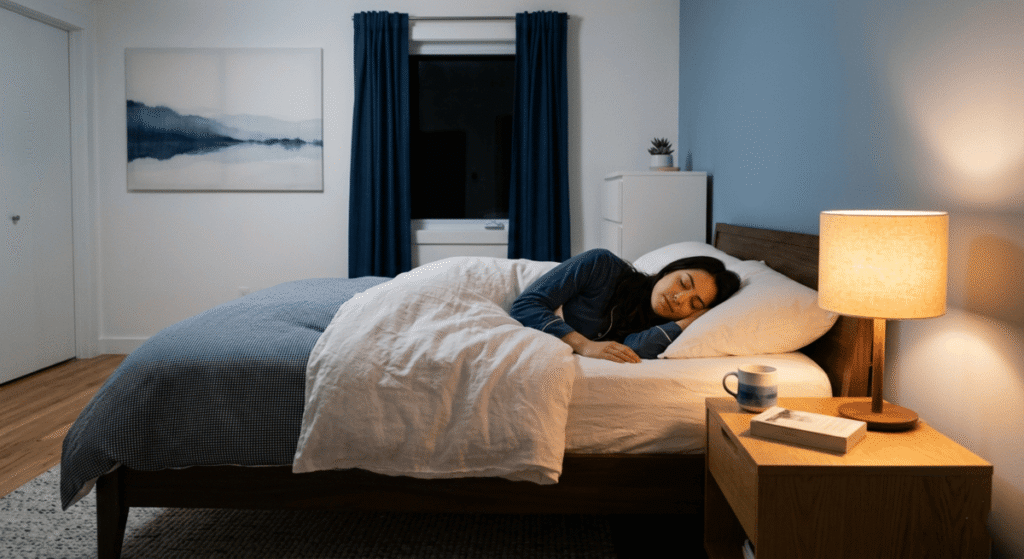
Reduce stimulation in the final hour. Bright screens, stressful news, and intense conversations keep your nervous system activated when it needs to be winding down. Replace them with dim light, calm reading, or gentle stretching.
Address the bedtime thought spiral directly. Keep a notepad beside your bed. When anxious thoughts surface at night, write them down. This simple act signals to your brain that the thought has been captured and does not need to be held in active memory.
Limit caffeine after 1 PM. Caffeine has a half-life of five to seven hours. A 3 PM coffee still has half its stimulant effect at 8 PM — which directly elevates cortisol and delays sleep onset.
Move your body during the day. Regular physical activity is one of the most evidence-backed ways to reduce both anxiety and sleep problems simultaneously. Even a 30-minute daily walk produces measurable improvements within two to three weeks.
Try a simple breathing practice before bed. The 4-7-8 method — inhale for four counts, hold for seven, exhale for eight — activates your parasympathetic nervous system and physically lowers your heart rate within minutes.
Common Misconceptions Worth Clearing Up
“My anxiety causes my sleep problems — not the other way around.” Often, both are true simultaneously. The relationship is bidirectional. Treating only the anxiety without addressing sleep quality means you are working with one hand tied behind your back.
“I just need medication to fix my anxiety.” Medication can be an important and valid tool. But if chronic poor sleep is the underlying driver of your anxiety, no medication will fully resolve it without also improving sleep quality. Both need attention.
“Sleeping more on weekends will fix the damage.” Weekend sleep recovery reduces acute fatigue but does not undo the neurological and hormonal disruption caused by a week of insufficient sleep. Consistency every night is what your nervous system actually needs.
“If I could just stop worrying, I would sleep fine.” The cycle often starts with sleep deprivation, creating anxiety, not anxiety creating sleep problems. Improving your sleep habits directly can reduce the worry that feels like the root cause.
FAQ
Can lack of sleep cause severe anxiety? Yes. Chronic sleep deprivation significantly increases amygdala reactivity, raises cortisol, and reduces the brain’s ability to regulate emotional responses — all of which can produce severe anxiety symptoms even in people with no prior anxiety history.
How do you get rid of sleep anxiety? Start with a consistent wake time, reduce evening stimulation, use a notepad to offload bedtime thoughts, and practice slow breathing before sleep. For persistent sleep anxiety, cognitive behavioural therapy for insomnia — known as CBT-I — is the most evidence-based treatment available.
Can lack of sleep cause anxiety attacks? Yes. Sleep deprivation lowers the threshold for panic by dysregulating your nervous system and heightening your threat response. People who are chronically sleep deprived are significantly more vulnerable to anxiety attacks, particularly in the morning after poor sleep.
How to calm your mind for sleep? Write down your thoughts before bed to clear mental clutter. Dim your lights an hour before sleep. Try slow diaphragmatic breathing. Keep your room cool. A consistent wind-down routine repeated nightly becomes a powerful sleep trigger over time.
The Bottom Line
Can lack of sleep cause anxiety and depression? The answer is yes — clearly, consistently, and in ways that science has documented thoroughly.
Your mental health and your sleep are not separate issues. They are the same issue viewed from two different angles.
The most important thing to understand is that you do not have to resolve your anxiety before you can improve your sleep — and you do not have to wait until your sleep is perfect before your mental health improves. Small, consistent changes to your sleep habits create real neurological changes that reduce anxiety and lift mood over time.
Start with one thing tonight. A consistent wake time. A notepad beside the bed. Ten minutes of calm before sleep.
Your brain is ready to recover. It just needs the conditions to do it.
Want to understand how sleep deprivation affects every part of your health and daily life? Read our complete guide to sleep deprivation for the full picture.