


You’ve had a decent night’s sleep. You’re not sick. But by mid-afternoon, you’re dragging.
It’s easy to blame stress or a bad night’s rest and move on. But there’s a simpler explanation a lot of people overlook.
Yes, dehydration can absolutely cause fatigue, and it’s often overlooked as a cause. In this guide, you’ll learn why dehydration drains your energy, how to tell if that’s what’s happening to you, and exactly how much water you actually need to fix it.
Key Takeaways
- Dehydration causes fatigue by reducing blood volume, which makes it harder for your body to deliver oxygen and nutrients efficiently.
- Research shows that even mild dehydration, as little as 1–2% of your body weight in fluid, can noticeably increase tiredness.
- Common signs your fatigue might be dehydration include dark urine, headache, dizziness, and trouble concentrating.
- Most healthy adults need somewhere around 2.7–3.7 liters of total water a day, though the right amount depends on your body and your day.
- Drinking water usually helps dehydration-related fatigue fairly quickly, though how fast varies from person to person.
- If your fatigue doesn’t improve with proper hydration, it’s worth talking to a doctor.
Does Dehydration Cause Fatigue?
Yes, dehydration can cause fatigue. When your body doesn’t have enough fluid, your blood volume drops, and that makes it harder for your heart to move oxygen and nutrients where they need to go.
That extra effort adds up. Your body starts working harder just to keep up with basic tasks, and you feel it as tiredness.
This isn’t just a hunch or an old wives’ tale. Researchers have measured it directly, and the connection between low fluid levels and low energy shows up consistently in controlled studies.
The tricky part is that dehydration fatigue often sneaks up on you. You might not feel obviously thirsty, but you can still feel the drag in your energy long before thirst kicks in.
Why Dehydration Causes Fatigue (What’s Actually Happening in Your Body)
Your blood is roughly half water. When you lose fluid and don’t replace it, your blood volume shrinks a little.
Think of it like a delivery truck running low on fuel. It can still make its rounds, but everything slows down.
With less blood volume, your heart has to work harder to circulate oxygen and nutrients to your muscles and brain. That extra strain is a big part of why dehydration leaves you feeling drained.
There’s also a hormonal piece to this. When your body senses that fluid levels are dropping, it releases a hormone called vasopressin, sometimes called antidiuretic hormone or ADH. Vasopressin tells your kidneys to hold onto more water and produce less urine, which is your body’s way of trying to protect itself from further fluid loss.
Vasopressin itself isn’t what makes you feel tired — think of it more as your body’s alarm system reacting to the real problem, which is that drop in blood volume and blood flow we just talked about. And on top of blood volume and hormone shifts, dehydration disrupts your electrolyte balance, the minerals like sodium and potassium that your muscles and nerves rely on to function properly.
When electrolytes fall out of balance, muscles work less efficiently and your body has to compensate. All of this together, the reduced blood volume, the hormonal response, and the electrolyte disruption, adds up to that heavy, low-energy feeling most people describe as fatigue.
Can Mild Dehydration Cause Fatigue Too?
You don’t need to be seriously dehydrated to feel it. Even mild dehydration can measurably affect your energy and mood.
In one study (Ganio et al., 2011), men who lost about 1.6% of their body weight in fluid showed increased fatigue and tension compared to when they were properly hydrated. A separate study (Armstrong et al., 2012) on women found something similar. Losing around 1.4% of body weight in fluid was enough to noticeably affect vigor, fatigue, and overall mood.
To put that in perspective, for someone who weighs 150 pounds, that’s a loss of only two to three pounds of water weight. That can happen over the course of an ordinary day if you’re not drinking much.
Interestingly, the research is less consistent when it comes to dehydration’s effect on things like memory or complex thinking tasks. Mood and fatigue tend to show up as more reliable effects than sharp cognitive impairment, at least at these milder levels.
Signs Your Fatigue Might Be Dehydration
Fatigue on its own can point to a lot of things. But when it shows up alongside certain other symptoms, dehydration becomes a much more likely explanation.
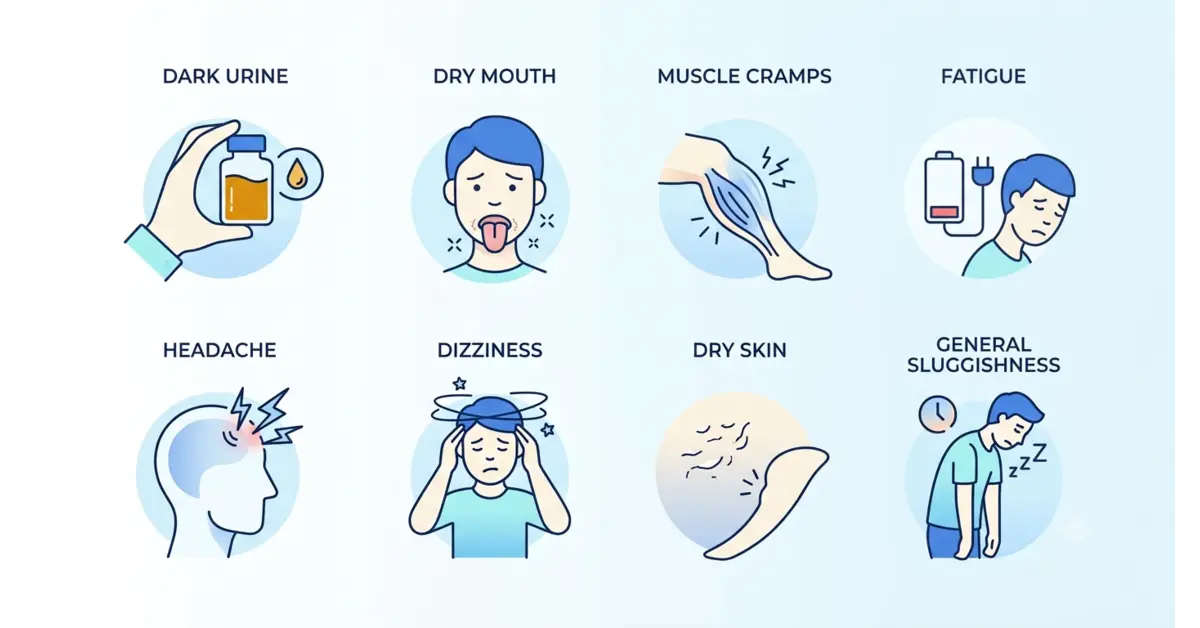
Common signs to watch for include:
- Dark yellow urine, or urinating less than usual
- Dry mouth or unusually strong thirst
- Headache
- Dizziness or lightheadedness
- Muscle cramps
- Dry skin
- A general feeling of sluggishness that doesn’t match how much you slept
Keep in mind that urine color alone isn’t a perfect indicator — certain foods, supplements, and medications can affect it too. But if you notice several of these signs together, especially dark urine paired with tiredness, dehydration is worth ruling in or out before you look elsewhere.
Dehydration, Brain Fog, and Trouble Concentrating
Along with physical tiredness, dehydration can bring on a mental fog that’s hard to describe but easy to recognize once you know what to look for.
You might find yourself rereading the same sentence, losing your train of thought mid-conversation, or just feeling mentally slower than usual.
Some research supports a link between dehydration and reduced concentration, though the findings here are a bit less consistent than the research on fatigue and mood specifically. Still, if you’re feeling foggy and can’t pin down why, hydration is a simple thing to check before assuming something more serious is going on.
Is This Dehydration — Or Just Normal Tiredness?
Here’s where a lot of people get stuck. Tiredness is so common that it’s easy to write off without asking why it’s actually happening.
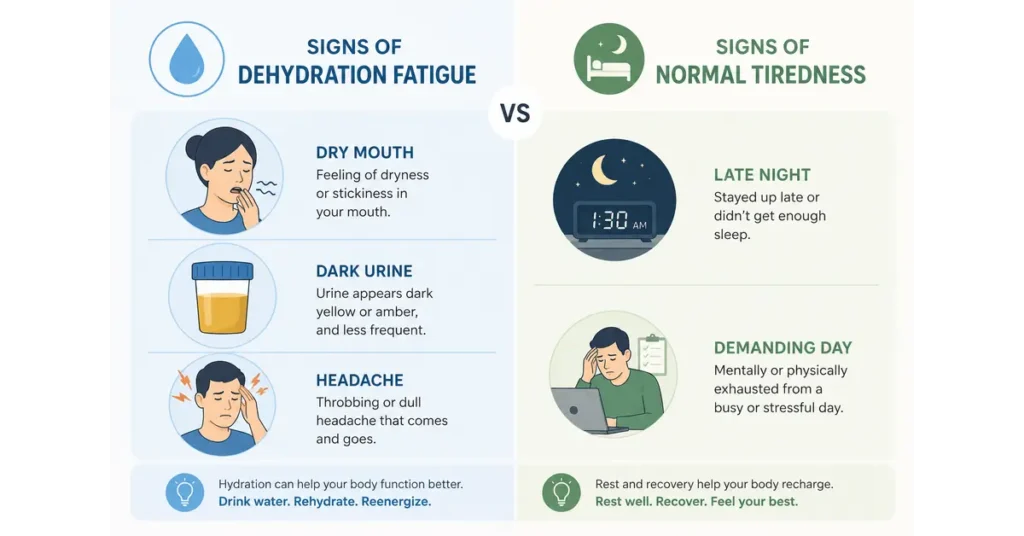
A useful place to start is thirst itself. There’s a difference between casual thirst, the kind you barely notice, and real thirst, the kind that makes you actively want water right now. If you’re at the point of real thirst, your body is already signaling that it’s behind on fluids.
Normal tiredness tends to show up on its own, usually tied to a late night, a demanding day, or a stretch of poor sleep. Dehydration-related fatigue tends to travel with company. It shows up alongside dry mouth, a headache, or that darker urine we mentioned earlier.
Timing can be a clue too. If your energy dips noticeably after a hot day, a workout, or several hours without drinking anything, dehydration is a reasonable first guess.
If your fatigue is more of a slow, ongoing pattern that doesn’t track with how much you’re drinking, it may be worth looking at other causes, including sleep quality or how consistently you’re eating throughout the day.
How Much Water Do You Actually Need?
There’s no single perfect number that applies to everyone, but there is a solid, evidence-based starting point.
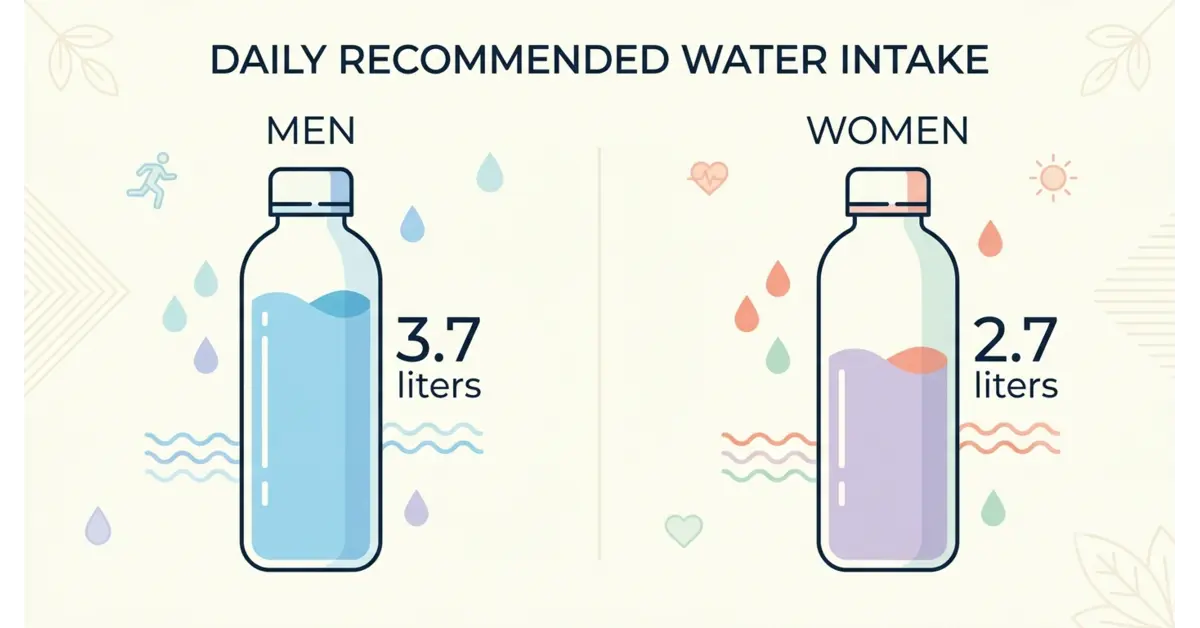
According to the National Academies of Sciences, Engineering, and Medicine, adequate total water intake for healthy adults is around 3.7 liters a day for men and 2.7 liters a day for women. That figure includes water from all sources, not just what you drink. Roughly 80% comes from beverages, and the rest comes from food.
The CDC doesn’t set one official fixed number, but generally points people toward 2 to 3 liters a day as a reasonable range, adjusted based on how active you are.
One thing worth clearing up: you may have heard that the vast majority of people walk around chronically dehydrated. That specific claim isn’t actually supported by the medical literature, so there’s no need to panic if you’re roughly in this range already.
Adjusting the Baseline for Your Weight and Body Size
There isn’t one official formula that calculates your exact number from your body weight, so it’s worth being cautious about any single “magic number” you see online.
That said, the National Academies figures give you a solid baseline to work from and adjust. If you’re on the smaller side, closer to the low end of that 2.7–3.7 liter range is usually reasonable. If you’re larger, more active, or sweat heavily, you’ll likely land closer to the higher end, or above it.
A practical approach many people find useful: start near the baseline for your sex, then adjust upward based on your activity level, the climate you’re in, and how your body actually responds. Your energy, your thirst, and the color of your urine are all useful everyday feedback.
Factors That Change How Much Water You Need
Your ideal water intake isn’t fixed. A few things shift it in either direction:
- Activity level. Exercise increases fluid loss through sweat, so active days call for more water than sedentary ones.
- Climate. Hot or humid conditions increase how much you sweat, even if you’re not exercising.
- Body size. Larger bodies generally need more total water.
- Age. Older adults often have a reduced sense of thirst, which can make it easier to fall behind without noticing.
It’s worth remembering that a fixed daily number doesn’t always tell the full story. A day spent mostly indoors with water nearby is very different from a day spent outside in the heat, even if you technically drink the same amount both times. On the outdoor day, that same intake might not be nearly enough. I’ve noticed this myself — on a day at home with a water bottle within reach, hitting my usual amount happens without even thinking about it. On a day spent outside, drinking that same amount can still leave me behind by evening.
What to Do If You’re Fatigued From Dehydration
If you suspect dehydration is behind your tiredness, the fix is usually straightforward: replace the fluids and electrolytes you’ve lost.
Plain water works well for ordinary, everyday mild dehydration. Drink steadily rather than gulping a large amount all at once and then forgetting about it for hours.
If you’ve lost a lot of fluid, whether from heavy sweating, intense exercise, heat, or being sick, an electrolyte drink can help you recover faster than water alone. This comes down to more than just replacing fluid. Electrolytes like sodium and potassium help your body actually hold onto and use that water effectively, which is part of why plain water sometimes doesn’t feel like it’s “hitting” the way you’d expect after intense activity. I notice this myself after playing football on weekends — plain water alone takes a while to feel refreshing, but an electrolyte drink gets me back to normal much faster.
For most people, dehydration-related fatigue tends to improve fairly quickly once you rehydrate properly, though exactly how fast varies from person to person. If your energy hasn’t budged after a day of consistent water intake, or if your fatigue feels severe or ongoing, it’s a good idea to check in with a doctor rather than assuming it’s just dehydration. That’s especially true if you notice things like confusion, a rapid heartbeat, fainting, or an inability to keep fluids down — those are signs to get medical attention rather than just drinking more water.
FAQs
Can dehydration cause fatigue even if I don’t feel very thirsty?
Yes. Fatigue can start setting in before your thirst signal becomes strong, which is part of why dehydration is so easy to miss. By the time you feel genuinely thirsty, you may already be running a fluid deficit.
Can drinking more water actually give me more energy?
For most people whose fatigue is tied to fluid loss, yes, rehydrating tends to help fairly quickly. If you’re already well-hydrated, though, drinking extra water beyond your needs isn’t likely to give you an additional energy boost.
How much water should I drink if I’m tired all day, not just occasionally?
Start with the general range of 2.7–3.7 liters a day as a baseline, then adjust for your activity level and environment. If persistent tiredness continues despite consistent hydration, it’s worth exploring other possible causes, like sleep quality or diet, rather than assuming it’s water alone.
Is dehydration fatigue different from being tired for other reasons?
It can be. Dehydration-related tiredness often shows up alongside other clues like dark urine, dry mouth, or a headache, and it tends to improve once you rehydrate. Tiredness from poor sleep or a demanding day usually doesn’t come with those same physical signs.
Can coffee or tea count toward my daily water intake?
Both contain water and do contribute meaningfully to your overall fluid intake, especially if you drink them regularly. Coffee and tea have a mild diuretic effect for some people, but for most regular drinkers, that effect doesn’t cancel out the fluid you’re taking in. Plain water is still a good primary source, but your morning coffee counts for more than you might think.
Conclusion
If you’ve been feeling unusually tired and can’t quite explain why, hydration is one of the simplest things to check before looking elsewhere. The link between dehydration and fatigue is well established: even mild dehydration can measurably affect your energy and mood.
Start by paying attention to your thirst, your urine color, and how you feel through the day. Small adjustments to how much and how consistently you drink can make a noticeable difference.
If you’re curious how hydration fits into the bigger picture of feeling tired, it’s worth reading up on the difference between everyday tiredness and more persistent fatigue.
Medical Disclaimer: This content is for informational and educational purposes only and is not intended to replace professional medical advice, diagnosis, or treatment. I am not a licensed healthcare professional. If your fatigue is severe, persistent, or accompanied by other concerning symptoms, consult a qualified healthcare provider before making decisions about your health.
Sources & References
- Ganio, M.S., et al. “Mild dehydration impairs cognitive performance and mood of men.” British Journal of Nutrition, 2011.
- Armstrong, L.E., et al. “Mild Dehydration Affects Mood in Healthy Young Women.” The Journal of Nutrition, 2012.
- National Academies of Sciences, Engineering, and Medicine. “Dietary Reference Intakes for Water, Potassium, Sodium, Chloride, and Sulfate,” 2005. nationalacademies.org
- Centers for Disease Control and Prevention (CDC), general hydration guidance, as referenced via NIH StatPearls, “Adult Dehydration,” 2025. ncbi.nlm.nih.gov/books/NBK555956
- Mayo Clinic. “Dehydration: Symptoms & Causes,” 2025. mayoclinic.org