
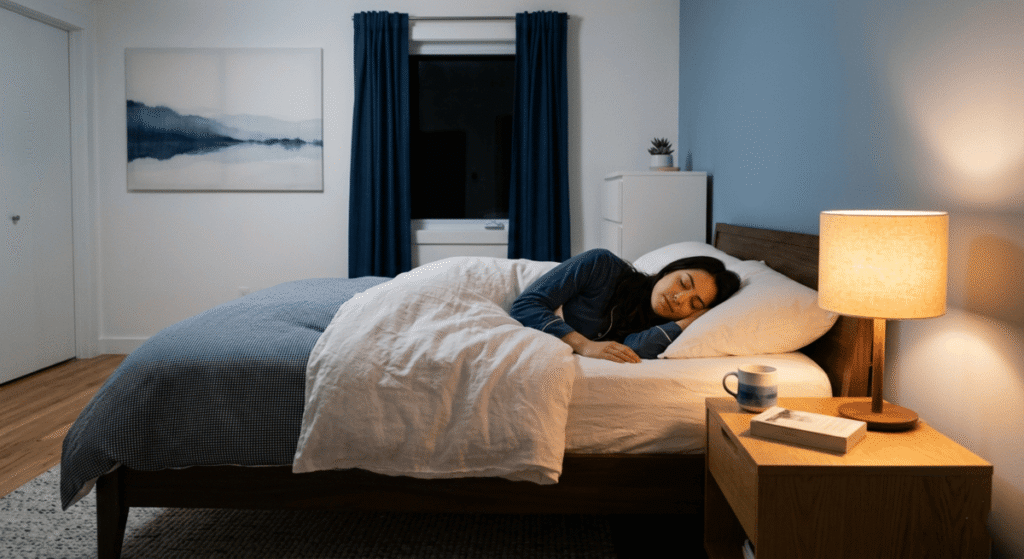
You set your alarm for 6 AM. You went to bed at midnight. You tell yourself six hours is fine, plenty of people run on less.
But by 2 PM you are staring at your screen, re-reading the same sentence four times, reaching for your third coffee, and wondering why you feel like your brain is wrapped in cotton wool.
Sound familiar?
You are not lazy. You are not weak. You are sleep deprived, and there is a very good chance you have been for longer than you realise.
This article gives you a straight, science-backed answer on whether six hours is truly enough, how much your body actually needs based on your age and lifestyle, and what you can do starting tonight to finally feel rested without overhauling your entire life.
What Actually Happens When You Sleep Only 6 Hours
Sleep is not just rest. It is active, biological maintenance.
While you sleep, your brain flushes out toxic waste products that build up during the day. Your body repairs muscle tissue. Your hormones reset. Your immune system strengthens. Your memories consolidate.
When you cut that process short, even by just one or two hours, none of those systems complete their job properly.
After just one week of sleeping six hours or less, studies have shown that cognitive performance drops to a level equivalent to being legally drunk. The frightening part? Most people in that state feel fine. They adapt to feeling tired and stop noticing how impaired they actually are.
This is called sleep debt, and it compounds silently over time.
So Is 6 Hours of Sleep Enough?
For the vast majority of adults, no.
The National Sleep Foundation and the American Academy of Sleep Medicine both recommend 7 to 9 hours per night for adults between 18 and 64. Only around 1 to 3 percent of the population carries a rare genetic mutation that allows them to genuinely thrive on six hours or less.
If you are reading this article, there is a very high chance you are not one of them.
Most people who believe they are “fine on six hours” have simply adapted to a lower baseline. They have forgotten what truly rested feels like.
How Much Sleep Do I Need By Age
Sleep needs change throughout your life. Here is a clear breakdown:
| Age Group | Recommended Sleep |
|---|---|
| Newborns (0–3 months) | 14–17 hours |
| Infants (4–11 months) | 12–15 hours |
| Toddlers (1–2 years) | 11–14 hours |
| Preschoolers (3–5 years) | 10–13 hours |
| School-age children (6–13) | 9–11 hours |
| Teenagers (14–17) | 8–10 hours |
| Young adults (18–25) | 7–9 hours |
| Adults (26–64) | 7–9 hours |
| Older adults (65+) | 7–8 hours |
The pattern is clear. The younger you are, the more sleep your body demands, because growth, development, and learning require it most intensely during those years.
How Much Sleep Do I Need to Grow Taller at 16
If you are a teenager wondering about this, the answer matters more than you might think.
The majority of human growth hormone, the hormone responsible for height and physical development, is released during deep sleep. Specifically, during the slow-wave sleep stages that only occur after you have been asleep for several hours.
Teenagers need 8 to 10 hours per night. Consistently sleeping less than that does not just make you tired. It can actively limit the release of growth hormone at the exact stage of life when your body needs it most.
If you are 16 and serious about your growth, your height goals, or your athletic development, sleep is not optional. It is part of the programme.
How Much Sleep Do I Need a Night, And Does Everyone Need the Same?
Not exactly. While 7 to 9 hours is the scientifically supported range for most adults, your personal sweet spot depends on several factors:
Your genetics — some people naturally sit at 7 hours, others genuinely need 9.
Your stress levels — high stress increases the body’s recovery demands during sleep.
Your physical activity — the more you train, the more repair your body requires overnight.
Your health status — illness, recovery from injury, and chronic conditions all increase sleep needs.
Your age — as shown above, younger people consistently need more.
The best way to find your personal number is simple. On a week where you have no alarm, notice what time you naturally wake up after going to bed at a consistent hour. That duration is likely close to your natural sleep need.
How Much Sleep Do I Need If I Workout
This is one of the most common questions from gym-goers and athletes, and the answer might surprise you.
If you train regularly, you almost certainly need more sleep than the average person, not the same amount.
Here is why. Exercise creates microscopic damage in muscle fibres. Your body repairs and rebuilds those fibres during sleep, specifically during deep sleep stages when human growth hormone is most active. If you are sleeping six hours and training hard, you are creating the damage but skipping the repair.
The result? Slower gains, higher injury risk, chronic fatigue, and reduced performance.
Most sports scientists recommend 8 to 10 hours for people in regular, intense training programmes. Even if you cannot hit that every night, prioritising sleep on training days and recovery days makes a significant difference to your results.
How Much Sleep Do I Need for Muscle Growth
Muscle is not built in the gym. It is built while you sleep.
When you lift weights or do resistance training, you are sending a signal to your body that it needs to adapt and grow stronger. But that adaptation only happens during recovery, and the most powerful recovery window is deep sleep.
During slow-wave sleep your body releases the highest concentrations of growth hormone, synthesises protein, and repairs damaged muscle tissue. Cut that window short and you are essentially doing the work without collecting the reward.
For anyone focused on muscle growth, 7 to 9 hours is the minimum. Elite athletes and bodybuilders routinely target 9 to 10. If your gains have stalled and your training and nutrition are dialled in, your sleep is the most likely culprit.
How Much Sleep Do I Need to Lose Weight
Here is a connection most people completely overlook, and it explains why so many people struggle with weight despite doing everything else right.
Sleep directly controls two key hunger hormones:
- Ghrelin — the hormone that makes you feel hungry. It rises sharply when you are sleep deprived.
- Leptin — the hormone that signals fullness. It drops when you do not get enough sleep.
This means that on six hours of sleep, your body is biochemically pushing you to eat more while simultaneously reducing your ability to feel satisfied. It is not a willpower problem. It is a hormonal problem caused by insufficient sleep.
Research has also shown that sleep deprivation increases cravings specifically for high-calorie, high-sugar foods. Your brain seeks quick energy to compensate for the fatigue.
If weight management is a goal, sleeping 7 to 9 hours is not just helpful, it is one of the most powerful things you can do alongside diet and exercise.
How Much Sleep Do I Need Woman
Women’s sleep needs are worth addressing separately because the research shows some important differences.
Studies have found that women tend to need slightly more sleep than men on average, approximately 20 minutes more per night. Women also experience greater cognitive impairment from sleep deprivation and take longer to recover from sleep debt.
Hormonal fluctuations across the menstrual cycle, pregnancy, and menopause all directly affect sleep quality and duration needs. During pregnancy, sleep needs increase significantly. During menopause, night sweats and hormonal changes can fragment sleep even when time in bed is adequate.
For women, aiming for the higher end of the 7 to 9 hour range, and paying attention to sleep quality not just quantity, is especially important.
How Much Sleep Do I Need Before an Exam
If you are pulling late nights before an exam, you are actively working against yourself.
Here is what the neuroscience shows. Memory consolidation, the process of taking what you studied and transferring it into long-term memory, happens almost entirely during sleep. Specifically during REM sleep, which occurs most abundantly in the final hours of a full night’s sleep.
When you cut sleep short to study more, you are not just tired the next day. You are literally deleting the information you stayed up to learn.
The advice is clear. Study with reasonable hours, review your material, then get a full 8 hours the night before your exam. You will perform significantly better than someone who crammed until 3 AM on four hours of sleep.
A well-rested brain recalls information faster, makes fewer errors, thinks more creatively, and manages exam anxiety better.
How Much Sleep Do I Need Calculator — How to Find Your Number
You do not need an app or a complex tool. Here is a simple method.
Step 1 — Count back from your wake-up time. If you need to be up at 7 AM and you need 8 hours, you should be asleep by 11 PM, which means in bed by 10:30 to account for the time it takes to fall asleep.
Step 2 — Sleep cycles last approximately 90 minutes. A full night typically covers 5 complete cycles. Try to time your sleep so you wake at the end of a cycle rather than in the middle of one. Waking mid-cycle is what causes that groggy, dragged feeling.
Step 3 — Track your natural wake time for a week without an alarm if possible. The average of those wake times, minus your consistent bedtime, gives you your personal sleep need.
Signs You Are Not Getting Enough Sleep
Do any of these sound familiar?
- You need an alarm to wake up every morning
- You feel groggy for 30 minutes or more after waking
- You rely on caffeine to function before midday
- You fall asleep within minutes of sitting still or watching something
- You feel irritable or emotionally reactive without obvious reason
- Your concentration drops sharply in the afternoon
- You get sick more often than you used to
If three or more of these apply to you regularly, your body is telling you something clearly. It needs more sleep.
Simple Ways to Start Sleeping Better Tonight
You do not need to change everything at once. Start here:
Set a consistent sleep and wake time — even on weekends. Your circadian rhythm thrives on consistency. One late Saturday night can disrupt your sleep quality for two or three days afterwards.
Avoid screens for 30 minutes before bed — the blue light emitted by phones and laptops suppresses melatonin, the hormone that signals your brain it is time to sleep.
Keep your bedroom cool and dark — your core body temperature needs to drop slightly to initiate sleep. A cool room accelerates that process.
Avoid caffeine after 2 PM — caffeine has a half-life of 5 to 7 hours. A coffee at 4 PM still has half its stimulant effect in your system at 9 PM.
Wind down deliberately — 20 to 30 minutes of something calm before bed – reading, light stretching, journalling, signals your nervous system to shift into rest mode.
Small, consistent changes compound quickly when it comes to sleep. Most people notice a difference within 3 to 5 days of improving their sleep habits.
FAQ
Is 6 hours of sleep enough for adults? For most adults, no. Research consistently shows that adults need 7 to 9 hours per night for optimal cognitive function, physical health, and emotional wellbeing. Only a very small percentage of people are genetically built to thrive on six hours.
What is the 10-5-3-2-1 rule for sleep? It is a wind-down framework. No caffeine 10 hours before bed, no food 5 hours before, no alcohol 3 hours before, no work or screens 2 hours before, and no phone 1 hour before bed. Following even part of this routine significantly improves sleep quality.
Is 7 hours of sleep enough? For many adults it sits within the recommended range and can be sufficient, especially if sleep quality is high. However, those who are physically active, under high stress, or recovering from illness will generally benefit from 8 or more hours.
Do adults need 7 or 8 hours of sleep? Both fall within the healthy range. The right amount depends on your individual biology, lifestyle, and health. If you wake naturally without an alarm feeling refreshed after 7 hours, that may be your number. If you need 8 to feel the same way, honour that.
Can you catch up on sleep over the weekend? Partially. You can reduce some of the immediate symptoms of sleep debt, but research shows you cannot fully reverse the cognitive and metabolic damage caused by a week of insufficient sleep in just two days. Consistency every night is far more effective than the binge-and-recover pattern.
How do I know if I am getting enough sleep? The clearest sign is waking up naturally without an alarm feeling rested and alert. If you need caffeine to function, struggle to concentrate, or feel tired most afternoons, you are likely not getting enough quality sleep.
The Bottom Line
Six hours might feel manageable. It might even feel normal if you have been doing it for years. But normal is not the same as optimal, and your brain, your body, your hormones, your muscles, and your immune system are all quietly paying the price.
The science is not ambiguous. Most adults need 7 to 9 hours. Athletes need more. Teenagers need more. Women often need more than they are getting.
Sleep is not a luxury or a reward for when life slows down. It is the foundation that everything else, your performance, your health, your mood, your weight, your gains, is built on.
Start tonight. Pick a bedtime. Stick to it. Your body will thank you in ways you will notice within days.
Want more practical, science-backed tips on sleep, health, and performance? Subscribe to our newsletter and get simple, actionable advice delivered straight to your inbox every week.
